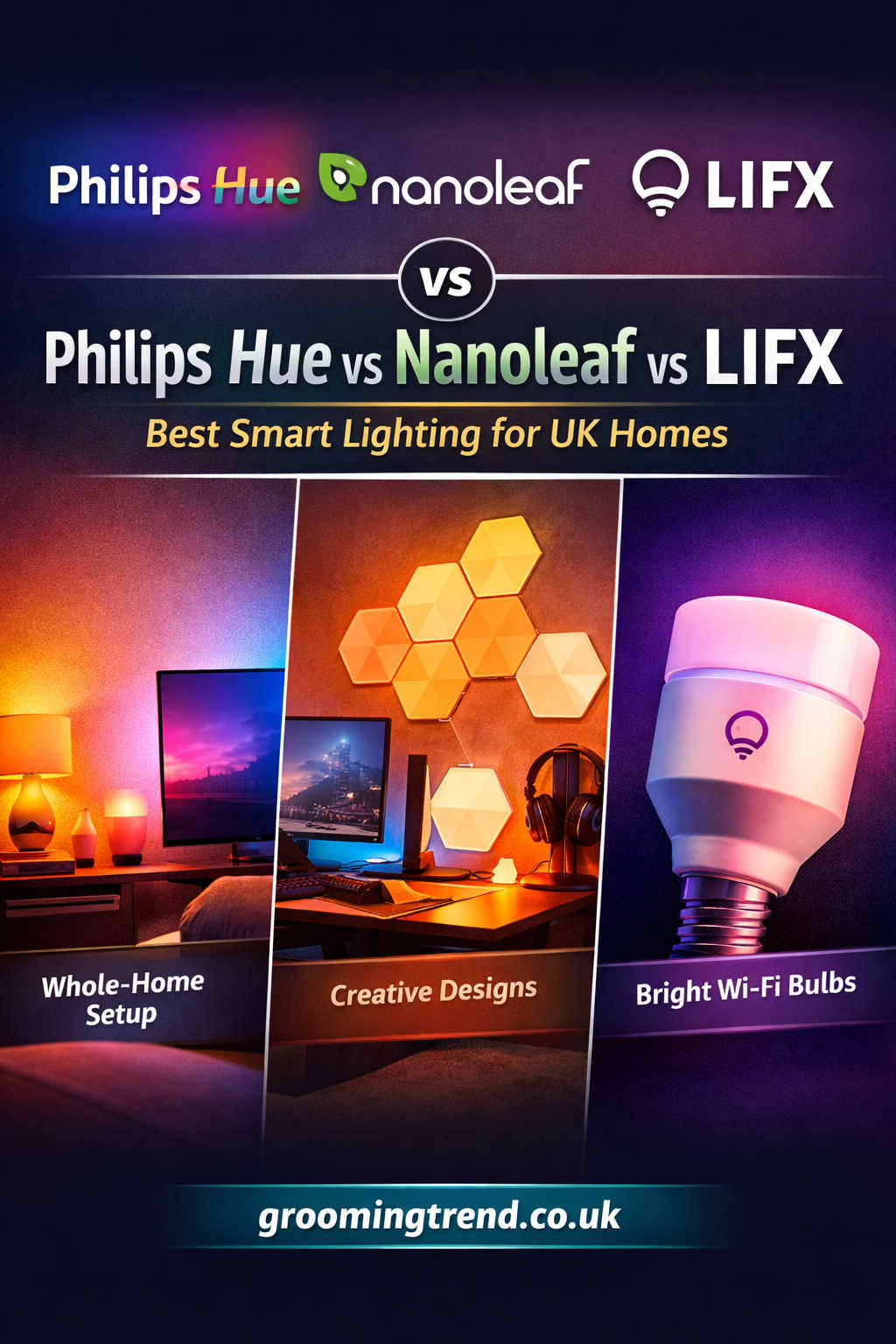
Smart lighting has become one of the most popular home upgrades across the UK. From improving ambience in living rooms to creating immersive gaming setups or automating daily routines, smart bulbs and lighting panels allow homeowners to transform how they use light in their homes.
Among the many brands available, three names stand out consistently: Philips Hue, Nanoleaf, and LIFX. Each brand offers colour-changing LEDs, app control, and compatibility with voice assistants such as Alexa, Google Assistant, and Apple Home. However, the way these systems work and the type of users they are designed for can be very different.
Some homeowners want a complete smart lighting ecosystem that can expand across every room. Others prefer creative lighting features for gaming or décor. And some people simply want bright, easy-to-install smart bulbs without complicated setup.
This guide compares Philips Hue, Nanoleaf, and LIFX in detail to help UK readers choose the right smart lighting system. We will examine brightness, connectivity, ease of setup, ecosystem size, pricing, and overall performance so you can decide which option suits your home best.
Understanding Smart Lighting Systems
Before comparing the brands, it helps to understand what makes smart lighting different from traditional bulbs.
Smart lighting products connect to your home network and allow you to control them through a smartphone app or voice commands. Instead of simply switching lights on or off, you can:
- Adjust brightness levels
- Change colours or colour temperatures
- Schedule lights to turn on automatically
- Sync lighting with music, films, or games
- Control lights remotely while away from home
For UK households adopting smart home technology, lighting is often the first and easiest upgrade because installation typically requires only replacing standard bulbs.
However, the underlying technology can vary. Some systems use Wi-Fi, while others rely on dedicated smart home protocols like Zigbee or Thread. These differences influence reliability, performance, and scalability.
Philips Hue Overview
Philips Hue is widely regarded as the most established and comprehensive smart lighting system available today. Created by Signify (formerly Philips Lighting), the platform has been evolving for more than a decade and has developed a large ecosystem of compatible products.
Why Philips Hue Is So Popular
The main reason Philips Hue remains a market leader is its reliability and expandability. The system uses a central device called the Hue Bridge, which connects lights through the Zigbee wireless protocol rather than directly through Wi-Fi.
Zigbee creates a mesh network where each light helps relay signals to others. This results in several advantages:
- Faster response times
- Greater stability compared with Wi-Fi bulbs
- Reduced strain on your home router
- Stronger connectivity across large homes
For households planning to install dozens of smart lights, this approach tends to perform better than Wi-Fi-based systems.
Range of Philips Hue Products
Another major strength of Philips Hue is the sheer variety of lighting products available.
UK homeowners can choose from:
- Standard E27 and B22 smart bulbs
- GU10 spotlights
- LED light strips
- Table and floor lamps
- Outdoor garden lighting
- Motion sensors and smart switches
- TV and gaming sync lighting
This large ecosystem allows you to expand your lighting system gradually over time.
Smart Features and Automation
The Hue mobile app includes a wide range of automation tools that make daily routines easier.
Common examples include:
- Wake-up lighting that gradually brightens in the morning
- Automatic evening dimming
- Motion-activated lighting in hallways
- Location-based automation when leaving or arriving home
The system also integrates smoothly with most major smart home platforms, including Amazon Alexa, Google Assistant, Apple HomeKit, and Samsung SmartThings.
Pros of Philips Hue
- Extremely reliable lighting system
- Huge range of bulbs, fixtures, and accessories
- Excellent colour accuracy and lighting quality
- Strong compatibility with smart home platforms
Cons of Philips Hue
- Higher prices compared with competitors
- Requires a Hue Bridge for full functionality
- Slightly lower brightness than some rival bulbs
Recommended Philips Hue Products for UK Homes
Popular choices include:
- Philips Hue White and Colour Ambiance Starter Kit – ideal for beginners
- Philips Hue Gradient Lightstrip – great for TVs and gaming setups
- Philips Hue GU10 Spotlights – perfect for kitchens and ceiling fixtures
These products are widely available from UK retailers such as Amazon, Currys, and John Lewis.
Nanoleaf Overview
Nanoleaf takes a very different approach to smart lighting. Instead of focusing primarily on bulbs, the company built its reputation around decorative modular lighting panels designed to turn walls into interactive light displays.
These lights are particularly popular among gamers, streamers, and people who want their lighting to double as interior design.
Modular Lighting Panels
Nanoleaf panels can be arranged in various shapes to create unique wall designs. Different panel types allow users to build patterns using triangles, hexagons, or linear bars.
Once installed, the panels can display dynamic lighting scenes with smooth colour transitions and animated patterns.
Many models also include interactive features such as:
- Touch-sensitive panels that respond when tapped
- Music visualisation that syncs lights with sound
- Animated scenes that change colours gradually
Because of these capabilities, Nanoleaf lights often become a centrepiece of a room rather than simply functional lighting.
Smart Connectivity
Nanoleaf products increasingly use Thread technology, a modern smart home protocol designed for low-latency communication between devices.
Thread networks operate locally and can improve reliability while reducing reliance on cloud services. Many Nanoleaf lights also support Matter, a new industry standard designed to improve compatibility between different smart home ecosystems.
Nanoleaf Smart Bulbs
Although the brand is best known for wall panels, Nanoleaf also offers smart bulbs under the Nanoleaf Essentials line.
These bulbs support millions of colours and typically reach brightness levels of around 1100 lumens, making them brighter than many competing smart bulbs.
Pros of Nanoleaf
- Unique decorative lighting designs
- Bright and vibrant colour output
- Thread and Matter compatibility
- Excellent for gaming rooms and feature walls
Cons of Nanoleaf
- Smaller product ecosystem compared with Philips Hue
- Panels can be expensive
- App experience may feel less polished at times
Recommended Nanoleaf Products for UK Buyers
Top Nanoleaf products include:
- Nanoleaf Shapes Hexagons Starter Kit – one of the most popular panel systems
- Nanoleaf Lines Smart Light Bars – ideal for modern gaming setups
- Nanoleaf Essentials Smart Bulb – affordable and bright lighting option
These products are commonly available through UK online retailers and electronics stores.
LIFX Overview
LIFX is known for producing some of the brightest and most colourful smart bulbs available. Unlike Philips Hue, LIFX products connect directly to your home Wi-Fi network and do not require a separate hub.
For many people, this makes LIFX one of the easiest smart lighting systems to install.
Simple Setup Without a Hub
The installation process for LIFX lights is straightforward:
- Screw the bulb into a socket
- Download the LIFX app
- Connect the bulb to your Wi-Fi network
This simplicity makes LIFX particularly attractive to people who want smart lighting without extra hardware.
Brightness and Colour Performance
LIFX bulbs are well known for their high brightness levels, often reaching 1100 lumens or more. This makes them a good option for rooms where strong illumination is needed.
They also support a wide colour temperature range, allowing users to switch between warm and cool lighting depending on the time of day.
Advanced Lighting Effects
The LIFX app includes several built-in lighting effects, such as:
- Animated colour themes
- Day-to-night lighting adjustments
- Music-reactive lighting
- Custom colour zones for light strips
These features allow users to create dynamic lighting environments without needing third-party apps.
Pros of LIFX
- No hub required
- Extremely bright bulbs
- Wide colour temperature range
- Feature-rich mobile app
Cons of LIFX
- Smaller ecosystem compared with Philips Hue
- Heavy Wi-Fi usage in large installations
- Fewer accessories and fixtures
Recommended LIFX Products
Popular options include:
- LIFX Colour A60 Smart Bulb – one of the brightest smart bulbs available
- LIFX Beam Wall Lights – stylish modular wall lighting
- LIFX Z LED Strip – excellent for desks, cabinets, and entertainment setups
These products are widely available from UK online retailers.
Brightness Comparison
Brightness is an important factor when choosing smart bulbs, especially for larger rooms.
Typical brightness levels are:
- LIFX bulbs: up to around 1100 lumens
- Nanoleaf bulbs: roughly 1100 lumens
- Philips Hue bulbs: typically around 800 lumens
While Philips Hue bulbs are slightly dimmer, they still provide enough illumination for most residential spaces.
Ease of Setup
If you want the simplest installation process, Wi-Fi bulbs have a clear advantage.
LIFX offers the easiest setup because it does not require additional hardware.
Nanoleaf is moderately easy to install, although arranging panel layouts may take some time.
Philips Hue requires a bridge for full functionality, which adds an extra step during setup but improves long-term reliability.
Ecosystem and Expandability
For users who plan to build a full smart home lighting system, ecosystem size is an important consideration.
Philips Hue clearly leads in this category. The brand offers dozens of bulbs, lamps, sensors, switches, and outdoor lights that all integrate into the same platform.
Nanoleaf focuses more heavily on decorative lighting panels, while LIFX concentrates primarily on bulbs and light strips.
If you want a lighting system that can grow across an entire home, Philips Hue remains the most versatile choice.
Price Comparison in the UK
Prices can vary depending on retailers and seasonal discounts, but typical UK price ranges are:
- Philips Hue colour bulbs: £45 to £60
- Nanoleaf Essentials bulbs: £20 to £30
- LIFX colour bulbs: £40 to £45
Nanoleaf panels are generally more expensive because they function as decorative lighting features rather than standard bulbs.
Starter kits with multiple lights often provide better value for new users.
Which Smart Lighting System Should You Choose?
The best option depends on how you plan to use smart lighting in your home.
Choose Philips Hue if you want
- A reliable system for the entire house
- Extensive automation features
- A large range of compatible lighting products
Philips Hue is ideal for homeowners building a long-term smart home ecosystem.
Choose Nanoleaf if you want
- Decorative wall lighting
- Unique room designs
- Interactive lighting for gaming or streaming
Nanoleaf excels at creative lighting setups that become a visual feature of the room.
Choose LIFX if you want
- Very bright smart bulbs
- Simple installation without a hub
- Powerful lighting effects
LIFX is perfect for people who want high-performance smart bulbs with minimal setup.
Frequently Asked Questions
Are smart lights worth buying in the UK?
Yes. Smart lighting can improve convenience, energy efficiency, and home ambience. Many systems also allow you to automate lighting schedules, which can help reduce electricity usage.
Do smart bulbs work without Wi-Fi?
Some systems require Wi-Fi for initial setup but continue working locally through hubs or smart home networks. For example, Philips Hue lights communicate through Zigbee once connected to the Hue Bridge.
Which smart lighting brand is most reliable?
Philips Hue is generally considered the most reliable system due to its Zigbee mesh network and mature ecosystem.
Can you mix different smart lighting brands?
It is possible if they support common platforms such as Amazon Alexa, Google Home, or Apple HomeKit. However, using a single ecosystem usually provides the best experience.
Are smart lights expensive to run?
LED smart bulbs are very energy efficient. Even when used frequently, their electricity consumption is typically much lower than traditional incandescent bulbs.
Final Verdict
Philips Hue, Nanoleaf, and LIFX each offer excellent smart lighting solutions, but they serve slightly different purposes.
Philips Hue remains the best overall choice for most UK households thanks to its reliability, large product ecosystem, and powerful automation features.
Nanoleaf stands out for decorative and creative lighting, making it a favourite for gaming setups and modern interiors.
LIFX provides extremely bright Wi-Fi bulbs with simple installation, making it ideal for users who want strong performance without complicated setup.
By understanding the strengths of each brand, you can choose a smart lighting system that fits your home, your budget, and your lifestyle.